
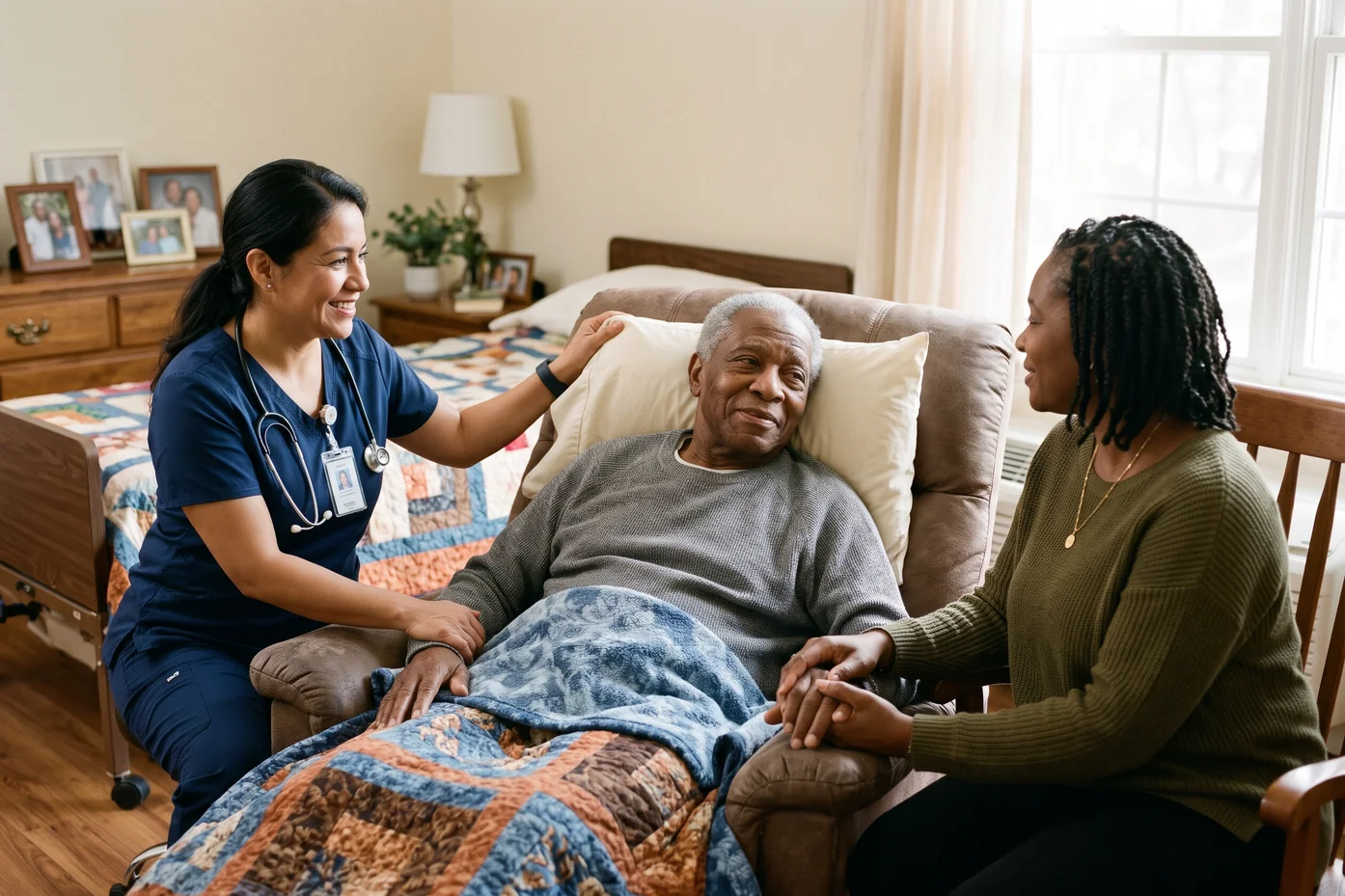
When a parent or spouse already lives in a nursing home and their health starts to decline, families often wonder whether this kind of comfort care means another move. It doesn’t. The care can come to them, right where they are, in the same room, with the same faces around them.
This guide explains how end-of-life care through hospice works in a nursing home: who qualifies, what the nursing home staff keeps doing, what the hospice team adds, and how the two work together. It also covers the basics of who pays. If you’re a son, daughter, or spouse trying to make sense of this for someone you love, you’ll come away knowing what to ask and what to expect. That matters, because many nursing home residents who could benefit never receive hospice care, or start it only in the final days.
Can You Get Hospice Care in a Nursing Home?
Yes. Hospice care is a kind of care, not a place. It goes wherever the patient calls home, and for many older adults, that’s a nursing home. About a quarter of adult deaths in the U.S. happen in nursing homes, according to a review of hospice care in U.S. nursing homes, so this is a very common situation.
Eligibility for hospice care is based on the patient’s medical condition and clinical findings, not their age or where they live. A resident in a nursing facility qualifies under the same rules as someone living in a private residence. Once they choose comfort care, a hospice care team visits the patient in the nursing facility, and the nursing home staff keeps caring for them day to day.
Residents who receive hospice care keep their room and their routine. Families sometimes ask about hospice in nursing home care because they’re afraid it means less attention. It’s actually the opposite. Your loved one gets two teams instead of one, each focused on a different part of their care.
Who Qualifies for Hospice in a Nursing Facility
Medicare’s rules are the same in every setting. According to Medicare.gov, the patient needs Medicare Part A (Hospital Insurance), and two doctors must certify eligibility: the hospice physician and the person’s regular doctor, if they have one. Together, they confirm the patient is terminally ill, with a life expectancy of six months or less if the terminal illness follows its usual course.
Common diagnoses include cancer and heart disease, along with lung disease, kidney failure, stroke, and advanced dementia, including late-stage Alzheimer’s disease. Dementia deserves a special mention here. Many nursing home residents live with it, and when cognitive decline becomes severe (for example, the patient can no longer speak more than a few words, walk, or eat without help), they may qualify. The National Institute on Aging has a helpful overview of how hospice care and palliative care fit people with serious illness.
Not sure if your loved one qualifies? Ask for a hospice evaluation. A nurse reviews the patient’s condition, medical records, and goals, then helps you decide whether services fit the resident’s needs and preferences. An evaluation is free and doesn’t commit anyone to anything.
To begin care, the patient signs a statement electing hospice care, sometimes called the election statement. If the patient can’t sign, a legal representative can. This form names the provider, the start date, and the attending doctor, and it confirms the choice of comfort care over curative medical treatments for the terminal illness.
How Hospice in a Nursing Home Works Day to Day
Think of it as a partnership. The nursing facility stays responsible for daily living, and the hospice care team takes the lead on comfort and end-of-life care needs. Federal rules spell this out for all hospice providers. Under 42 CFR 418.112, the hospice and the nursing facility must sign a written agreement before care begins, describing who does what and how they’ll communicate 24 hours a day.
What the Nursing Home Staff Keeps Doing
Regular nursing home staff continue providing daily care while hospice care focuses on end-of-life care. That includes meals, bathing, dressing, help with the bathroom, giving routine medications, laundry, and keeping the room clean. This kind of everyday help is called custodial care, and the nursing facility keeps providing it at the same level as before. Federal rules require the facility to keep meeting the patient’s personal care and nursing needs around the clock.
The good news is that your loved one keeps the facility staff they already know. The aide who knows how they like their coffee, or which side of the bed they sleep on, is still there. That continuity is a real comfort near the end of life.
What the Hospice Team Adds
The hospice care team brings an extra layer of support. It’s led by a hospice medical director and usually includes a hospice physician, registered nurses, a home health aide, social workers, a chaplain, and trained volunteers. These healthcare professionals visit on a schedule set by the care plan and come more often as needs change.
The hospice care team develops an individualized care plan addressing medical, physical, emotional, and spiritual needs. In practice, the care team provides prescription drugs, medical supplies, and equipment related to the terminal diagnosis, plus expert pain management and symptom management. That can mean adjusting medicines to manage pain, easing shortness of breath, treating nausea and other symptoms, and handling wound care so the patient stays comfortable.
The care team will also provide support for the people around the patient. The hospice team assists with emotional and spiritual support for residents and their family members, and it guides families on what to expect as a resident’s condition changes. Grief support doesn’t stop when your loved one dies. Medicare requires hospices to offer bereavement services to families for up to a year after a death, and many extend grief support to families for up to 13 months post-loss. At St. Margaret’s, our bereavement care continues for 13 months.
How the Two Teams Work Together
Good hospice care depends on coordination between the nursing home and hospice staff. The written plan of care states which team handles each task, and it’s created with input from the nursing facility, the hospice care team, and the patient’s family. If the patient’s condition changes, the nursing facility must notify the hospice team right away.
Here’s one place this coordination really shows. When a crisis happens at 2 a.m., a patient without hospice care might be sent to the emergency room. With hospice care, the facility staff calls the hospice nurse first, and hospital transfers may be avoided through onsite crisis management by hospice teams. A nurse can come in, adjust medications, and keep the patient comfortable in their own bed. Some families want a hospital transfer anyway, and that’s their right, but many are relieved to have another option.
Benefits of Hospice for Nursing Home Residents
Hospice care improves pain management for nursing home residents, and that’s not a small thing. Research summarized in the review by Monroe and Carter found that residents of these homes often don’t get adequate pain relief or high-quality palliative care at the end of life, especially residents with dementia, who may struggle to describe their pain. Hospice nurses are trained to spot pain in people who can’t put it into words.
Patients receiving hospice care also tend to have fewer acute hospital admissions. That same review cites a study that found hospice enrollment in nursing homes reduced hospitalizations in the last 30 days of life, translating into savings of $2,909 in acute medical care for every nursing home resident. It also notes that hospice care saved Medicare about $7,000 for people with cancer and $3,500 for people with other conditions over the course of the illness. Fewer ambulance rides and hospital stays usually mean a calmer, more peaceful hospice experience, too.
Most of all, hospice care helps ensure dignity and comfort at the end of life. It improves quality of life for the patient, and it gives families support at a time when it’s easy to feel alone. A dual approach that blends nursing home care with hospice services gives residents the best of both: familiar daily care and specialized comfort care.
Why So Few Nursing Home Residents Use Hospice
Given those benefits, you might expect it to be standard in every nursing facility. It isn’t. The Monroe and Carter review reports that about 24% of nursing home residents who die there qualify for hospice services, but only 6% are enrolled. Another study it cites found that only 30% of nursing homes had residents enrolled. Those are older figures, but the barriers behind them still come up today.
- Staff knowledge. In one survey, 92% of hospice nurses (and 26% of nursing home nurses) said nursing home staff’s limited knowledge of hospice care was a barrier. When staff don’t bring it up, families may never hear about it.
- Concerns about dementia care. 17% of nursing home nurses in one survey believed hospice staff lacked the skills to care for residents with dementia.
- Accepting the diagnosis. One study found 56% of patients and families were reluctant to accept a terminal diagnosis. That’s deeply human. Nobody wants to believe the dying process has started.
- Payment incentives. The review also notes that nursing homes receive more money for rehabilitative care than for palliative care, which can quietly discourage referrals.
The takeaway for families is simple: you don’t have to wait for someone else to suggest it. You can ask for an evaluation yourself. If you’re not sure how to start that conversation, our guide on how to talk to a parent about hospice can help.
Who Pays for Hospice in a Nursing Home
Here’s the short version. Medicare covers hospice care for eligible nursing home residents through the Medicare hospice benefit. Under Medicare, hospice care includes the hospice team’s visits, medications, medical equipment, and supplies related to the terminal illness, usually at little or no cost to the family.
What the hospice benefit doesn’t pay for is the nursing home’s daily charge for the room, meals, and custodial care. Medicare.gov is clear that nursing home room and board isn’t covered by the Medicare hospice benefit. That cost is usually paid the same way it was before: privately, through long-term care insurance, or by Medicaid. When Medicaid covers the stay, the state pays the hospice, and the hospice pays the nursing home, according to the hospice benefit policy manual from the Centers for Medicare and Medicaid Services, part of the U.S. Department of Health and Human Services.
Two other details matter for residents. A person can sometimes use the Medicare skilled nursing facility benefit for an unrelated condition at the same time they receive hospice care for the terminal illness. And the hospice respite care benefit generally isn’t available to people who already live in a facility, since respite is meant to give a home caregiver a break.
For the full picture of the Medicare benefit, including benefit periods, what’s covered and what isn’t, and copays, read our guide: Does Medicare Cover Hospice? If you’re weighing the bigger budget, our article on paying for senior care may help too.
Hospice vs. Palliative Care in a Nursing Home
These two terms get mixed up a lot. Palliative care is comfort-focused care that can be provided at any stage of illness, even while someone is still receiving treatment to cure it. Hospice care is for patients with a life expectancy of six months or less, and it focuses on comfort care, not curative treatments.
In a nursing home setting, a patient might receive palliative care for months or years while they still receive treatment for a chronic illness. When treatment stops helping, or the patient decides it’s too much, hospice care becomes the next step. Our article on hospice vs. palliative care explains the differences in more detail. Both focus on quality of life.
Hospice in Assisted Living Facilities and Other Settings
Nursing homes aren’t the only places people receive hospice care. It also serves people in assisted living facilities, memory care, and other residential care settings, as well as in a private residence. In assisted living, the arrangement is similar: the assisted living staff and any paid caregivers handle daily support, and the hospice care team handles comfort, symptom control, and medical care related to the illness.
The main difference is the level of daily help. Assisted living facilities usually offer less hands-on nursing than a nursing facility, so families sometimes add private aides as needs grow. A nursing home setting already provides 24-hour nursing, which can make it easier to keep someone comfortable in their final weeks. Our guide on skilled nursing vs. assisted living compares the two.
Some people also receive short-term hospice care in a hospital or nursing home when symptoms are hard to control at home. Wherever it happens, the goal is the same.
How to Start Hospice for a Loved One in a Nursing Home
If you think it’s time, here’s a simple path forward.
Start the conversation. Talk with your loved one, if they’re able, about what matters most to them. Advance care plans typically include discussions about goals of care, advance directives, and treatment decisions, so pull out any documents they’ve already signed.
Ask for an evaluation. Ask the nursing home’s social worker, nurse, or attending doctor for a hospice referral. You can also call hospice providers directly.
Choose a provider. Not all hospice providers are the same. The patient has the right to choose one, and Medicare only pays a Medicare-approved hospice provider. Ask the nursing facility which hospice providers it already has agreements with, and compare quality ratings on Medicare Care Compare, a federal tool from the Department of Health and Human Services. Good questions to ask: How often will the nurse visit? Who answers the phone at night? How do you coordinate with facility staff?
Sign and begin. After the patient signs the election statement, the hospice team builds the care plan with the nursing home, and services can often start quickly.
Hospice Care at St. Margaret’s
St. Margaret’s has cared for New Orleans families since 1889, and we’re a Medicare-approved hospice provider offering compassionate end-of-life care. Our in-facility hospice care is offered in our household-model communities, where residents live in small, homelike households with nursing on site around the clock. That includes St. Margaret’s at Mercy at 3525 Bienville Street in Mid-City and St. Jude’s at 450 S Claiborne Ave Bldg A, New Orleans, LA 70112.
Because our nursing and hospice teams are part of the same organization, coordination is built in. Your loved one doesn’t have to change rooms or meet a whole new staff, and your family gets one place to call with questions. If your loved one lives at home instead, our in-home hospice care brings the same team to you.
To talk with our team, call (504) 373-5923 or schedule a visit.
Frequently Asked Questions
Does My Loved One Have to Leave the Nursing Home to Receive Hospice Services?
No. The hospice care team comes to the nursing facility. The patient stays in their room, with the same facility staff, and the team visits the patient there.
Does the Nursing Home Staff Stop Caring for a Resident on Hospice?
No. Nursing home staff keep providing daily care, meals, and personal help. The hospice care team adds pain control, relief for other symptoms, emotional and spiritual support, and guidance for family members.
Can a Patient Still Receive Treatment for Other Medical Conditions?
Yes. The hospice benefit covers the terminal illness and related conditions. A patient can still receive treatment for unrelated medical conditions, like an infection or a broken bone, through their regular coverage.
Will Medicare Pay the Nursing Home Bill Once Hospice Starts?
No. The Medicare hospice benefit pays for hospice services, not the nursing home’s daily rate for living there. See our Medicare hospice guide for the full breakdown.
Who Should We Call During a Crisis?
Call the hospice first, or ask the nursing home staff to. Their nurses are on call 24 hours a day for hospice patients and can often handle problems on site, without a trip to the hospital.
Can We Stop Hospice If Things Change?
Yes. A patient can stop hospice at any time and return to regular Medicare coverage. Sometimes a patient’s condition improves and their life expectancy is no longer six months or less; in that case, hospice care ends and regular coverage resumes. If they qualify again later, they can restart it.
Comfort, Right Where They Live
Hospice in a nursing home lets your loved one stay in a familiar place while gaining a team focused on comfort, dignity, and family support. The nursing home handles daily care, the hospice care team handles pain, other symptoms, and end-of-life care, and Medicare covers the hospice side for eligible residents.
If you’ve been wondering whether it’s time, you don’t have to decide alone or all at once. Start by asking for an evaluation. At St. Margaret’s, we’re happy to talk it through with you. Call our hospice team at (504) 373-5923.