Moving your body is one of the best things you can do at any age, and it matters even more as the years add up. The right exercises for seniors can make everyday life easier, from getting up out of a chair to carrying groceries to walking around the block without worrying about a fall.
The good news? You don’t need a gym membership, fancy equipment, or hours of free time. Most of the moves in this guide can be done at home with a sturdy chair, a wall, and maybe a pair of light dumbbells or a few resistance bands.
This guide is for older adults who want to stay active and for the families who love them. We’ll walk through balance, strength, chair, core, cardio, and stretching exercises, plus safety tips and a simple weekly plan you can start this week. Along the way, you’ll see how a little regular exercise helps seniors build strength, improve balance, and stay independent for years to come.
Why Exercise Matters for Seniors
Staying active as we age does a lot more than keep us in shape. It supports overall health, mobility, and the kind of independence most of us want to hold onto for as long as possible.
Here’s the reality. Starting in middle age, we slowly lose muscle mass, and that loss speeds up later in life. Doctors call this sarcopenia. Weaker muscles make daily tasks like climbing stairs, getting out of the car, or lifting a laundry basket harder than they used to be. Research suggests that about 30% of adults over 70 already have some trouble getting around.
The good news is that regular exercise can slow or even reverse a lot of that decline. Physical activity helps seniors:
Build strength and keep their muscles working
Improve balance and lower the risk of falls
Improve flexibility and ease joint stiffness
Boost energy levels and sleep better
Lift their mood and support mental health
Protect their heart, bones, and memory
Maybe the biggest benefit is this: regular exercise lowers the risk of functional decline. In plain terms, that means it helps people keep doing the things they love on their own, from cooking a favorite meal to taking an evening walk around the neighborhood.
It’s never too late to start, either. Older adults who begin an exercise program in their 70s, 80s, and even 90s can still build strength and see real gains in how they move and feel.
How Much Exercise Do Seniors Need?
The Centers for Disease Control and Prevention (CDC) recommends that adults 65 and older get about 150 minutes of moderate exercise each week. That works out to roughly 30 minutes a day, five days a week. Brisk walking is one of the easiest ways to get there.
On top of that, the CDC suggests strength training at least two days a week, working all the major muscle groups. Older adults should also add balance training, ideally three or more days a week.
So what counts as moderate exercise? It’s any activity that raises your heart rate and breathing. You should be able to talk, but not sing. These endurance activities are what keep your heart and lungs in good working order.
Most experts break a well-rounded fitness routine for older adults into four types of exercise:
Endurance (aerobic) exercise like walking, swimming, or dancing
Strength exercise with light weights, resistance bands, or your own body weight
Balance exercise like standing on one foot or tai chi
Flexibility exercise like gentle stretching
Don’t let the numbers scare you off. If 30 minutes feels like a lot right now, break it into three 10-minute sessions. Some movement is always better than none, and you can build up from there.
Safety Tips Before Seniors Start Exercising
A little planning goes a long way toward keeping your workout safe and injury-free. Before you dive in, keep these tips in mind.
Talk to your doctor first. This is especially important if you have heart disease, diabetes, arthritis, or you’ve had a recent fall or surgery. Your doctor can tell you which moves to focus on and which to skip before you begin a new exercise program.
Warm up and cool down. Spend five minutes marching in place, rolling your shoulders, or walking slowly before each session. Finish with a few minutes of gentle stretching. This helps protect your muscles and joints.
Use support. Keep a sturdy chair, a kitchen counter, or a wall within reach for any standing exercise. Choose a chair without wheels or arms that get in the way.
Wear the right gear. Supportive, non-slip shoes and comfortable clothes make a big difference. Skip socks on smooth floors.
Drink water. This matters even more here in New Orleans, where heat and humidity can sneak up on you. Exercise indoors or early in the morning on hot days.
Start slow. Begin with a few repetitions and add more as you get stronger. Mild muscle soreness the next day is normal. Sharp or lasting pain is not.
Know when to stop. Stop right away if you feel dizzy, short of breath, or notice an irregular heartbeat, and let your doctor know. Call 911 for chest pain or pressure, or any symptom that feels severe.
Balance Exercises for Seniors
Balance is the first thing to work on if you want to stay on your feet. Better stability is one of the best ways to prevent trips and falls, and studies show balance exercises can greatly lower fall risk for seniors. Aim for at least three balance sessions a week. Each one only takes about 10 minutes.
Do every move below next to a sturdy chair or counter you can grab if you need it. As you get steadier, try holding on with one finger, then not at all.
Single-Leg Stand
Single-leg stands build stability and balance in older adults, and they’re easy to do anywhere.
Stand behind a chair and hold the back with both hands. Lift one foot a few inches off the floor and hold for 10 seconds. Lower it and switch sides. Work up to 30 seconds per leg. Once that feels easy, try it while you brush your teeth or wait for the coffee to brew.
Heel-to-Toe Walk
Heel-to-toe walking sharpens coordination and balance, which helps you stay steady on uneven sidewalks.
Stand next to a wall or counter. Place the heel of one foot right in front of the toes of the other. Take 10 to 20 steps this way, keeping your eyes ahead instead of on your feet. Turn around and walk back.
Weight Shifts
Stand with your feet hip-width apart and hold a chair. Slowly shift your weight onto your right foot until your left foot feels light. Hold for a few seconds, then shift to the left. Repeat 10 times per side. This simple exercise teaches your body to control where your weight goes.
Standing Marches
Hold the back of a chair and march in place, lifting your knees as high as feels comfortable. Keep your back tall. March for 30 seconds to a minute. Standing marches help with balance and lower body strength at the same time.
Clock Reach
Picture yourself standing in the middle of a clock face. Hold a chair with your left hand and stand on your left foot. Reach your right arm forward toward 12 o’clock, then out to the side at 3 o’clock, then back toward 6 o’clock. Return to center and switch sides. Go slow and keep your standing knee soft.
Safety tip: If you feel unsteady, put your foot down and reset. Balance gets better with practice, not by pushing through a wobble.
Strength Exercises for Seniors
Strength training is the best tool we have against age-related muscle loss. Doing it twice a week helps seniors manage sarcopenia, keep their muscle mass, and build strength they can feel in everyday life. It also increases bone density and lowers the risk of falls and fractures.
You don’t need heavy weights. Light weights, resistance bands, or just your own body weight work well. Start with one set of 8 to 12 repetitions for each move and rest a day between strength sessions.
Sit-to-Stand (Chair Squats)
If you only do one exercise, make it this one. It copies a move you make dozens of times a day.
Sit near the front edge of a sturdy chair with your feet flat and hip-width apart. Cross your arms over your chest or reach them forward. Lean forward slightly and stand up, pushing through your heels. Slowly sit back down. If that’s too hard, use your hands on the armrests to help. Aim for 10 reps.
Wall Push-Ups
These bodyweight exercises build upper body strength without getting down on the floor.
Stand about an arm’s length from a wall. Place your palms flat on the wall at shoulder height. Bend your elbows and lean your chest toward the wall, keeping your body straight. Push back to the start. Do 10 to 15 reps. Step farther from the wall to make it harder.
Bicep Curls
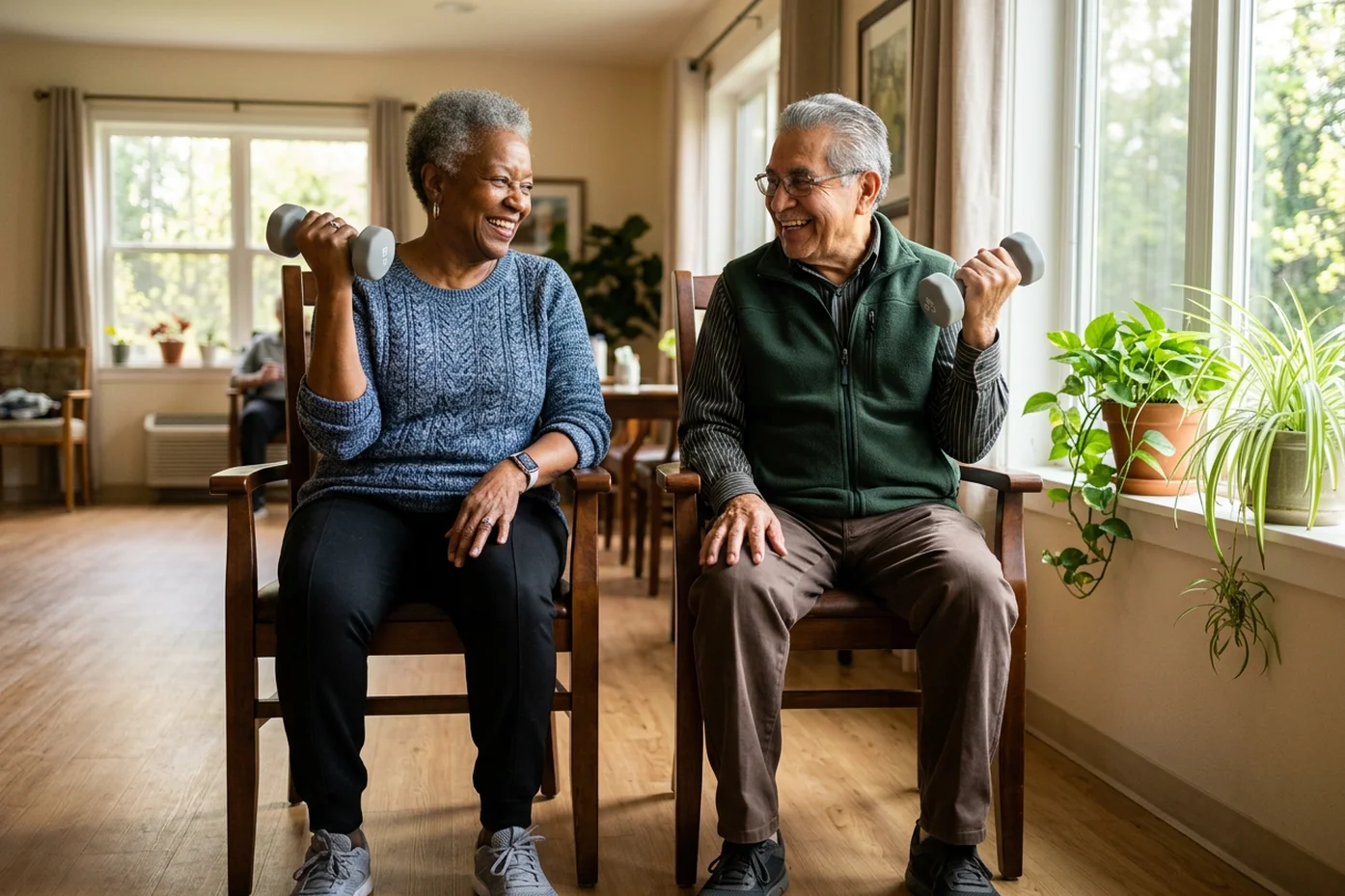
Sit or stand holding a light weight in each hand, palms facing up. A soup can or water bottle works if you don’t have weights. Keep your elbows close to your sides and slowly curl the weights up toward your shoulders. Lower them back down with control. Do 10 to 12 reps.
Overhead Press
Sit tall in a chair holding light weights at shoulder height, palms facing forward. Press the weights straight up overhead without locking your elbows. Lower them slowly back to your shoulders. Do 8 to 10 reps. This helps with reaching high shelves and putting dishes away.
Farmer’s Carry
Hold a light weight or a full grocery bag in each hand with your arms at your sides. Stand tall and walk slowly for 20 to 30 steps. This works your grip, shoulders, core, and legs all at once, and it’s exactly what you do when you bring in the groceries.
Safety tip: Breathe out as you lift and breathe in as you lower. Never hold your breath during strengthening exercises.
Resistance Band Exercises for Seniors
Resistance bands are cheap, light, and easy on the joints, which makes them a great fit for older adults. They come in different colors for different strength levels, so you can start easy and move up as you get stronger. You can find an affordable set at most sporting goods stores.
Seated Band Row
Sit tall in a chair with your legs out in front of you. Loop the middle of the band around the bottoms of your feet and hold one end in each hand. Pull the band toward your belly, squeezing your shoulder blades together. Slowly let your arms go forward again. Do 10 to 12 reps. This helps with posture and upper back strength.
Band Chest Press
Wrap the band behind your back at shoulder blade level and hold an end in each hand near your chest. Press both hands straight forward until your arms are almost straight. Slowly bring them back. Do 10 to 12 reps.
Seated Band Leg Press
Sit in a chair and loop the band around the bottom of one foot, holding the ends in your hands. Bring your knee toward your chest, then press your foot forward against the band until your leg is almost straight. Do 10 reps and switch legs.
Band Side Steps
Tie a light band in a loop just above your knees or around your ankles. Stand with your feet hip-width apart and hold onto a counter. Take a small step to the side, then bring your other foot over. Take 10 steps one way and 10 back. This strengthens the hips, which play a big part in balance.
Safety tip: Check your bands for small tears before each use, and keep a firm grip so they don’t snap back.
Leg Strengthening Exercises for Seniors
Your legs carry you through the whole day. Strong legs make it easier to walk, climb stairs, get in and out of the car, and catch yourself if you start to trip. That’s why leg strength matters so much for older adults who want to keep their independence.
Seated Leg Extensions
Sit tall in a chair with your feet flat. Slowly straighten one leg out in front of you until it’s level with the seat. Hold for two seconds, squeezing the muscle on top of your thigh. Lower it slowly. Do 10 reps on each leg. Add an ankle weight once this gets easy.
Calf Raises
Stand behind a chair and hold the back. Rise up onto your toes as high as you can, then slowly lower your heels. Do 10 to 15 reps. Strong calves help you push off when you walk and keep your ankles steady.
Standing Hamstring Curls
Hold the back of a chair. Bend one knee and bring your heel up toward your backside, keeping your thighs lined up. Slowly lower your foot. Do 10 reps per leg.
Side Leg Raises
Stand behind a chair holding on with both hands. Keep your back straight and slowly lift one leg out to the side, toes pointing forward. Lower it with control. Do 10 reps per side. This works the outer hip muscles that keep you from tipping sideways.
Step-Ups
Use the bottom step of a staircase with a railing. Hold the rail, step up with your right foot, then bring your left foot up. Step back down one foot at a time. Do 10 reps leading with each leg.
Glute Bridges
Lie on your back on a bed or mat with your knees bent and feet flat. Squeeze your backside and lift your hips until your body makes a straight line from shoulders to knees. Hold for two seconds and lower. Do 10 reps. Bridges strengthen the hips and lower back.
Chair Exercises for Seniors
Chair exercises are a great choice for anyone who has trouble standing for long periods, is recovering from an illness, or simply wants a safe place to start. A regular chair workout improves strength and flexibility, reduces stiffness, and can even help with balance.
The best part is that chair exercises can be adapted for every fitness level. Beginners can do fewer reps and smaller movements. More active seniors can add light weights or speed up the pace.
Use a sturdy chair without wheels, and sit near the front edge with your back tall and feet flat on the floor.
Seated Marches
While sitting tall, lift your right knee as high as is comfortable, then lower it. Do the same with your left. Keep marching for 30 seconds to a minute, swinging your arms if you can. This warms up the body and gets your heart rate up a little.
Seated Leg Lifts
Hold the sides of the chair seat. Straighten one leg out in front of you and lift it a few inches off the floor. Hold for three seconds and lower. Do 10 reps per leg. This builds the thigh and hip muscles you use to walk.
Seated Torso Twists
Sit tall and cross your arms over your chest. Slowly turn your upper body to the right as far as is comfortable, keeping your hips facing forward. Return to center and turn to the left. Do 10 twists per side. This loosens the spine and helps you turn to look over your shoulder when driving.
Arm Circles
Hold your arms straight out to your sides at shoulder height. Make small forward circles for 15 seconds, then small backward circles for 15 seconds. Rest and repeat. Arm circles ease shoulder stiffness and build endurance in the upper body.
Seated Heel and Toe Raises
Keep your feet flat on the floor. Lift both heels as high as you can, then lower them. Next, lift your toes while keeping your heels down. Alternate for 20 reps. This keeps the ankles flexible and helps blood flow in the legs.
Chair Punches
Make loose fists and hold them near your chest. Punch your right arm forward, pull it back, and punch with your left. Keep a steady rhythm for 30 seconds to a minute. Chair punches are a fun way to raise your heart rate without standing up.
Safety tip: Keep your feet flat and your back supported. If your chair slides, put it against a wall or on a rug with a non-slip pad.
Core Exercises for Seniors
Your core is more than your stomach muscles. It includes your back, sides, and hips, and it’s what keeps you upright and steady. A strong core improves posture, eases back pain, and makes everyday moves like bending, twisting, and getting out of bed much easier.
These core exercises start seated and move to the floor or a wall, so pick the ones that fit your comfort level.
Seated Core Exercises for Seniors
Seated knee lifts: Sit near the front of a sturdy chair and lean back slightly, holding the sides of the seat. Tighten your stomach and lift both knees a few inches, then lower them. Start with 5 reps and work up to 10.
Seated side bends: Sit tall with your arms at your sides. Slowly lean to the right, sliding your hand toward the floor, then come back up using your side muscles. Repeat to the left. Do 8 to 10 per side.
Pelvic Tilts
Lie on your back on a bed or mat with your knees bent and feet flat. Tighten your stomach and gently press your lower back flat against the surface, tilting your hips up slightly. Hold for five seconds and relax. Do 10 reps. This is a gentle way to wake up the deep core muscles and ease lower back stiffness.
Bird Dog
Get on your hands and knees on a mat, or try a standing version by leaning your hands on a counter. Reach your right arm forward and your left leg back at the same time, keeping your back flat. Hold for a few seconds, return, and switch sides. Do 8 reps per side. Bird dogs train balance and core strength together.
Modified Plank Exercises for Seniors
A full plank on the floor is too much for many older adults, but modified planks give you the same benefits with less strain.
Wall plank: Stand facing a wall and place your forearms on it at shoulder height. Step your feet back until your body leans at a slight angle in a straight line. Tighten your stomach and hold for 10 to 20 seconds.
Counter plank: Once the wall plank feels easy, try the same move with your forearms on a sturdy kitchen counter. Work up to 30 seconds.
Safety tip: Keep breathing during every core exercise. If you feel pain in your lower back, stop and try a gentler version.
Low-Impact Cardio Exercises for Seniors
Cardio, also called endurance exercise, raises your heart rate and breathing. Over time, it strengthens your heart and lungs, boosts energy levels, and makes it easier to keep up with grandkids, errands, and outings.
Low impact exercises are the way to go for most older adults. They keep at least one foot on the ground or use water to support your body, so there’s less pounding on your knees, hips, and ankles.
Walking Exercises for Seniors
Walking is free, easy, and can be done almost anywhere. Experts recommend walking for about 30 minutes most days of the week.
Start with 10 minutes at a comfortable pace and add a few minutes each week. To turn it into exercise, walk briskly enough that you breathe harder but can still talk. Walk with a friend, explore a park, or do laps inside a mall on hot or rainy days.
Water Exercises for Seniors
Water is one of the kindest places to exercise. When you’re standing in water up to your neck, the water supports about 90% of your body weight, which takes a lot of stress off your joints. Water aerobics also improves flexibility and range of motion.
Try walking laps in the shallow end, marching in place, or doing arm circles under the water. Many community pools and gyms offer water aerobics classes made for older adults.
Stationary Bike Exercises for Seniors
A stationary bike gives you a solid cardio workout while you sit. Recumbent bikes, the kind with a back rest, are extra comfortable and easy to get on and off. Start with 10 minutes at a light resistance and slowly build up to 20 or 30 minutes.
Dance Exercises for Seniors
Dancing is exercise that doesn’t feel like exercise. Put on your favorite music, whether that’s jazz, gospel, or a little brass band, and move. Step side to side, sway your arms, and tap your feet. Dancing builds endurance, balance, and memory as you learn new steps, and it’s a great mood booster.
Chair Aerobics for Seniors
If standing for long is hard, you can still get your heart pumping from a chair. Combine seated marches, chair punches, and arm circles to music for 10 to 20 minutes. Move a little faster as you get stronger.
Safety tip: You should be able to talk during cardio. If you’re too out of breath to speak, slow down.
Stretching Exercises for Seniors
As we age, muscles and joints tend to tighten up. Flexibility exercises help widen your range of motion so you can reach, bend, and turn more easily. Regular stretching also reduces stiffness, and daily stretching can improve mobility and balance.
Pair your stretching routines with strength training for the best results. Together, strength and flexibility exercises help protect your joints.
For each stretch below, move slowly until you feel a gentle pull, not pain. Hold each stretch for at least 30 seconds and breathe normally. Never bounce.
Neck Stretch
Sit or stand tall. Slowly tilt your right ear toward your right shoulder until you feel a stretch on the left side of your neck. Hold, then switch sides. This eases tension from reading, screens, or sleeping in an awkward position.
Shoulder Rolls
Sit tall with your arms relaxed. Roll your shoulders up toward your ears, back, and down in a slow circle. Do 10 rolls, then reverse direction. This is a great way to start any stretching routine.
Chest Opener
Sit near the front of a chair or stand tall. Clasp your hands behind your back, or hold the sides of the chair seat, and gently squeeze your shoulder blades together while lifting your chest. Hold for 30 seconds. This stretch helps undo the rounded shoulders that hurt posture.
Seated Hamstring Stretch
Sit on the edge of a chair and straighten one leg in front of you with your heel on the floor. Keep your back straight and lean forward from your hips until you feel a stretch behind your thigh. Hold, then switch legs.
Calf Stretch
Stand facing a wall with your hands on it. Step one foot back and press that heel into the floor while bending your front knee. You’ll feel a stretch in the back of your lower leg. Hold, then switch sides.
Mobility Exercises for Seniors
Mobility exercises gently move your joints through their full range to keep them working well. They’re a perfect warm-up and can be done every day.
Ankle circles: Sit and lift one foot. Circle your ankle 10 times each way.
Hip circles: Stand holding a counter with your hands on your hips. Make slow circles with your hips, 10 each way.
Wrist rolls: Hold your arms out and slowly roll your wrists in circles, 10 each way.
Safety tip: Stretch after a short warm-up, not when your muscles are cold. A few minutes of marching in place is enough.
Tai Chi and Yoga Exercises for Seniors
If you like slow, calm movement, tai chi and yoga are worth a try. Both mix balance, strength, and flexibility with focused breathing, and both can be done standing or seated.
Tai Chi Exercises for Seniors
Tai chi is a gentle Chinese practice made up of slow, flowing movements. It improves movement, balance, and flexibility for seniors, and research shows it’s one of the most effective ways to improve balance and reduce falls.
A simple move to try is "weight shifting with arm waves." Stand with your feet a little wider than your hips and knees soft. Slowly shift your weight to your right foot while you raise your arms in front of you to shoulder height. Shift back to the left as your arms float down. Keep it slow and smooth for one to two minutes.
Many community centers, churches, and senior fitness programs in the New Orleans area offer beginner tai chi classes. A class is a great way to learn proper form and meet new people.
Chair Yoga Exercises for Seniors
Chair yoga takes classic yoga poses and adapts them so you can do them while sitting or holding a chair. It builds flexibility, eases joint pain, and helps you relax.
Seated cat-cow: Sit tall with your hands on your knees. As you breathe in, arch your back and lift your chest. As you breathe out, round your back and tuck your chin. Repeat 8 times.
Seated mountain pose: Sit tall with your feet flat. Breathe in and raise your arms overhead. Hold for a few breaths, then lower your arms as you breathe out.
Seated forward fold: Sit with your feet flat and slowly fold forward from your hips, letting your arms hang toward the floor. Hold for 30 seconds, then roll up slowly. Skip this one if you have osteoporosis.
Bed Exercises for Seniors
Not everyone can stand or sit for long, especially after a surgery, a hospital stay, or during a long illness. Bed exercises help keep muscles working and blood flowing even when getting up is hard. They’re often part of recovery plans, but check with your doctor or therapist before you start.
Ankle Pumps
Lie on your back with your legs straight. Point your toes away from you, then pull them back toward you. Do 20 slow pumps. This simple move helps circulation and lowers the risk of blood clots when you’re less active.
Heel Slides
Lie on your back with your legs straight. Slowly slide one heel toward your backside, bending your knee. Slide it back out. Do 10 reps per leg. Heel slides keep the knees and hips moving.
Bed Bridges
Lie on your back with your knees bent and feet flat on the mattress. Squeeze your backside and lift your hips a few inches. Hold for two seconds and lower. Do 5 to 10 reps. This builds the hip and leg strength you need to roll over and get out of bed.
Arm Raises
Lie on your back holding a small pillow or rolled towel with both hands. Keep your arms straight and slowly raise them up over your head as far as is comfortable, then lower them. Do 10 reps. This keeps the shoulders from stiffening up.
Exercises for Seniors With Health Conditions
Having a chronic health condition doesn’t mean you have to stop moving. In most cases, the right kind of exercise actually helps. The tips below are a general starting point. A physical therapist can build a plan that fits your body and your goals.
Exercises for Seniors With Arthritis
Arthritis is very common. According to the CDC, about 47% of adults 65 and older have been diagnosed with it. Exercise is one of the best ways to manage arthritis pain and keep joints moving.
Focus on low-impact cardio like walking, cycling, and water aerobics, along with gentle stretching and light strength training. Warm water is especially soothing for stiff joints. On days when your joints flare up, scale back to range-of-motion moves like ankle circles and shoulder rolls instead of skipping movement altogether.
Exercises for Seniors With Osteoporosis
Weight-bearing exercises like walking, dancing, and stair climbing help keep bones strong. Strength training with light weights or resistance bands helps too. Balance exercises are a must, since preventing falls also prevents fractures.
Avoid moves that round your spine forward, like toe touches and sit-ups, and avoid deep twisting. Ask your doctor which exercises are safe for your bone density.
Exercises for Seniors With Lower Back Pain
Gentle movement usually helps back pain more than rest does. Pelvic tilts, glute bridges, bird dogs, and short walks all strengthen the muscles that support your spine. Gentle stretches for the hamstrings and hips can ease the pull on your lower back.
Stop any exercise that causes sharp pain or pain that shoots down your leg, and let your doctor know.
Exercises for Seniors With COPD
For people with COPD or other lung conditions, regular activity can make breathing feel easier over time. Walking, stationary cycling, and arm exercises with light weights are common choices.
Try pursed-lip breathing as you exercise. Breathe in through your nose for two counts, then breathe out slowly through pursed lips for four counts. Many people with COPD do best in a supervised pulmonary rehab program, so ask your doctor about one.
Brain Exercises for Seniors
Your mind needs exercise too. Physical activity itself is good for the brain, since it boosts blood flow and supports memory. But mental workouts help keep thinking skills sharp as well.
Good brain exercises for seniors include crossword puzzles, word searches, sudoku, card games, and jigsaw puzzles. Learning something new, like a language, an instrument, or a new recipe, gives the brain an even bigger challenge. Reading and talking about a book with friends counts too.
Staying social is one of the best things you can do for your mind. Joining a class, volunteering, or simply sharing a meal with friends keeps the brain engaged. Group activities like dance or tai chi classes are a smart way to exercise body and mind at the same time.
For families caring for someone with memory loss, gentle movement and familiar activities can still bring comfort and connection. Our guide on how to visit a loved one with dementia shares more ideas, and our article on memory care explains when a little extra support may help.
A Simple Weekly Exercise Plan for Seniors
Putting it all together can feel like a lot, so here’s a simple weekly exercise routine to get you started. It covers all four types of exercise and includes about 150 minutes of moderate activity, in line with CDC guidelines.
| Day | Activity | Time |
|---|---|---|
| Monday | Brisk walk + balance exercises | 30 min + 10 min |
| Tuesday | Strength training + short walk + stretching | 25 min + 15 min + 10 min |
| Wednesday | Water aerobics or stationary bike + balance exercises | 30 min + 10 min |
| Thursday | Brisk walk + chair yoga or stretching | 30 min + 15 min |
| Friday | Strength training + short walk + balance exercises | 25 min + 15 min + 10 min |
| Saturday | Dance or tai chi class | 30 min |
| Sunday | Rest | — |
You can swap days around to fit your schedule. Just try to leave a rest day between strength sessions, and stretch a little every day if you can.
New to exercise? Cut every time in half for the first two weeks, then slowly build up. Writing your workouts on a calendar is an easy way to stay motivated and see how far you’ve come.
How to Help an Aging Parent Stay Active
If you’re an adult child trying to get Mom or Dad moving, you’re not alone. Many seniors know exercise is good for them but struggle to get started. A little encouragement from family can make a big difference.
Do it together. Invite your parent on a walk after dinner, or try a few chair exercises side by side while you visit. Exercise feels less like a chore when it’s time spent together.
Tie it to things they enjoy. If your dad loves gardening, that’s bending, lifting, and walking. If your mom loves music, put on her favorite songs and dance in the kitchen. Movement doesn’t have to look like a workout to count.
Start small and celebrate wins. Five minutes a day is a fine place to begin. Notice and praise progress, like getting out of a chair without using the armrests or walking to the corner and back.
Make home safer. Clear clutter from walkways, add grab bars in the bathroom, and make sure rugs don’t slip. A safer home makes it easier to stay active without fear of falling.
Ask about support. If your parent has had a fall, a hospital stay, or a big drop in strength, a physical therapist can help them rebuild safely. That professional guidance often gives seniors the confidence to keep moving on their own.
How Physical Therapy Helps Seniors Stay Active
Sometimes exercising on your own isn’t enough, especially after a fall, surgery, stroke, or hospital stay. That’s where physical therapy comes in. A therapist looks at how you move, finds your weak spots, and builds a plan to help you regain strength, improve balance, and get back to your daily tasks safely.
At St. Margaret’s, therapy is part of everyday life. Our St. Margaret’s at Mercy and St. Jude’s communities offer on-site therapy through Gulf South Therapy, along with short-term rehab for people recovering from a surgery or hospital stay. Our goal is simple: to support independence and help each person get back to the life they love, whether that means returning home or living comfortably with us.
Want to learn more about short-term rehab or therapy at St. Margaret’s? Call us at (504) 321-6555 or schedule a visit to see our communities in person.
Frequently Asked Questions About Exercises for Seniors
What Is the Best Exercise for Seniors?
There’s no single best exercise, because older adults need a mix of cardio, strength, balance, and flexibility. If you had to pick one, walking is hard to beat. It’s free, low impact, and good for your heart, legs, balance, and mood. Sit-to-stand chair squats are a close second for building leg strength.
How Often Should Seniors Exercise?
The CDC recommends about 150 minutes of moderate activity a week, such as 30 minutes on five days. Seniors should also do strength training at least two days a week and balance exercises about three days a week.
What Exercises Should Seniors Avoid?
In general, older adults should avoid high-impact moves like jumping and running on hard surfaces, heavy lifting with poor form, and exercises that put a lot of strain on the neck or lower back, like full sit-ups. People with osteoporosis should avoid bending forward at the waist and deep twisting. Always check with your doctor about your own situation.
Can Seniors Over 80 Still Build Strength?
Yes. Research shows people in their 80s and 90s can still build muscle and strength with regular strength training. Start with light weights or your own body weight, go slowly, and be consistent.
What Are Good Exercises for Seniors With Limited Mobility?
Chair exercises and bed exercises are great options. Seated marches, seated leg lifts, arm circles, ankle pumps, and heel slides all keep the body moving without standing. A physical therapist can help you find safe ways to build up from there.
How Can Seniors Improve Their Balance at Home?
Practice balance exercises like single-leg stands, heel-to-toe walks, and weight shifts at least three times a week, always next to a sturdy chair or counter. Tai chi is another proven way to improve balance and lower fall risk.
Is Walking Enough Exercise for Seniors?
Walking is a great foundation, but it’s not the whole picture. To stay strong and steady, seniors should also add strength training, balance exercises, and stretching to their weekly routine.
Start Moving Today
The best exercises for seniors are the ones you’ll actually do. Pick two or three moves from this guide that feel doable, put them on your calendar, and start this week. Over time, add a little more balance work, a little more strength training, and a few more minutes of walking.
Every step you take helps you stay fit, stay active, and stay independent. And if you or someone you love needs extra help getting back on your feet, the team at St. Margaret’s is here for you. Call (504) 321-6555 or schedule a visit to learn how our therapy and rehab services can help.