
Maybe your mom has started forgetting to turn off the stove. Maybe your dad asks the same question three times in one visit, or gets turned around driving a route he’s taken for twenty years. Once enough of these moments start stacking up, the question comes fast: what is memory care, and is it time to start looking into it for someone you love? That’s a big, unsettling question, and there’s no shame in not having a clear answer yet — most families don’t, at first.
This article is here to walk you through it. We’ll explain what memory care actually is, who it’s for, and how it’s different from assisted living and a regular nursing home. We’ll also cover what it typically costs, what a typical day looks like, and how to know when it’s time to start looking. Not all memory care facilities are the same, and understanding the differences will help you evaluate options with more confidence.
What Is Memory Care?
Memory care is a specialized type of long-term care designed for people living with Alzheimer’s disease, dementia, or other forms of memory loss. It’s not just assisted living with a different name — memory care facilities are built and staffed specifically around the needs of people whose memory, judgment, and safety awareness have changed. Memory care services typically offer assistance with bathing, dressing, medication management, and other specialized care built around dementia, not just general supervision.
At its core, memory care combines three things: a secure environment, specialized staff trained in dementia care, and a daily structure designed to reduce confusion and anxiety. Memory care facilities have 24-hour supervision for residents, which means someone trained to recognize the signs of distress or wandering is always present. Specialized staff in memory care are trained specifically in this kind of care, not just general senior care, so they understand why a resident might repeat a question five times in ten minutes or become agitated in the late afternoon (a pattern often called “sundowning”).
Memory care communities emphasize structured routines for residents to reduce anxiety, and that structure — consistent meal times, familiar activities, predictable staff — is one of the most important things memory care offers. For someone whose internal sense of time and place is unreliable, a stable outside routine can be genuinely calming.
Who Needs Memory Care? Early Signs to Watch For
Not everyone with memory loss needs memory care right away. Age-related forgetfulness — misplacing keys, blanking on a name — is common and usually harmless. The bigger concern is when memory problems start to affect daily life and safety. Not every family recognizes memory issues right away, especially when a loved one is skilled at covering for them. If you’re trying to sort out where the line is, our article on age-related memory loss vs. dementia breaks down the difference in more depth. Family members are usually the ones who notice these changes first, since cognitive decline and cognitive impairment often develop gradually rather than overnight.
Some early signs family members notice: a parent leaving the stove on, getting lost on a drive they’ve taken for years, forgetting to eat or take medication, or becoming confused about the day or season. Many families notice these changes gradually, then realize all at once how much has shifted. Safety concerns are usually what tips the decision — wandering out of the house, a fall that wasn’t reported, or a near-miss with cooking or driving.
Dementia patients often go through early stages of cognitive impairment where they’re still mostly independent, followed by a slower decline in judgment and safety awareness. Memory care is generally the right fit once daily supervision becomes a real safety issue, not just a convenience. A trusted doctor can help you sort out where your loved one currently stands and whether memory care, or a less intensive option, makes sense for now.
Memory Care vs. Assisted Living: What’s the Difference?
This is probably the question we hear most, and it makes sense — assisted living and memory care can look similar from the outside. Both offer help with personal care tasks like bathing, dressing, and medication management, and both offer support with activities of daily living more broadly. The real difference is in the level of supervision, the physical environment, and the staff training.
Assisted living is built for people who need some help with daily tasks but are otherwise safe and independent — they can typically come and go, manage their own schedule, and don’t need constant supervision. Assisted living communities and assisted living facilities generally have a more open layout and a lighter staff-to-resident ratio than memory care.
Memory care, by contrast, is built around residents who can no longer safely manage on their own because of cognitive decline. Memory care units include secured outdoor areas to prevent wandering and use alarmed doors to enhance resident safety — features you generally won’t find in standard assisted living. Staff members in memory care are also trained specifically in dementia care, including how to redirect confusion or agitation without causing more distress. If your loved one is transitioning from independent living or assisted living and their needs are outpacing what that setting can safely provide, memory care is usually the next step.
Memory Care vs. a Nursing Home
It’s easy to lump memory care in with a nursing home, but they serve different purposes. A nursing home (also called a skilled nursing facility) is built primarily around medical care — residents who need ongoing nursing supervision, wound care, IV therapy, or recovery support after a hospital stay. A nursing home’s staff and services are organized around physical health needs first.
Memory care is organized around cognitive and safety needs first. A resident in memory care may be physically healthy and mobile — the issue isn’t their body, it’s that dementia has made it unsafe for them to live independently. That said, the two aren’t mutually exclusive: some memory care communities exist inside a larger nursing home campus, and residents can transition between skilled nursing and memory care if their medical needs change. If your loved one also has ongoing health issues that need regular medical care, a campus offering both skilled nursing and memory care facilities may be the better fit. If you’re still weighing where your loved one fits best, our article on skilled nursing vs. assisted living is a useful next read.
Dementia Care and Alzheimer’s Disease: What Memory Care Actually Provides
Alzheimer’s disease is the most common cause of dementia, and it’s the reason most families first start looking into memory care. Over 5 million Americans have Alzheimer’s disease, according to the AARP, and that number is one reason memory care has become such a well-developed, specialized field rather than a niche service.
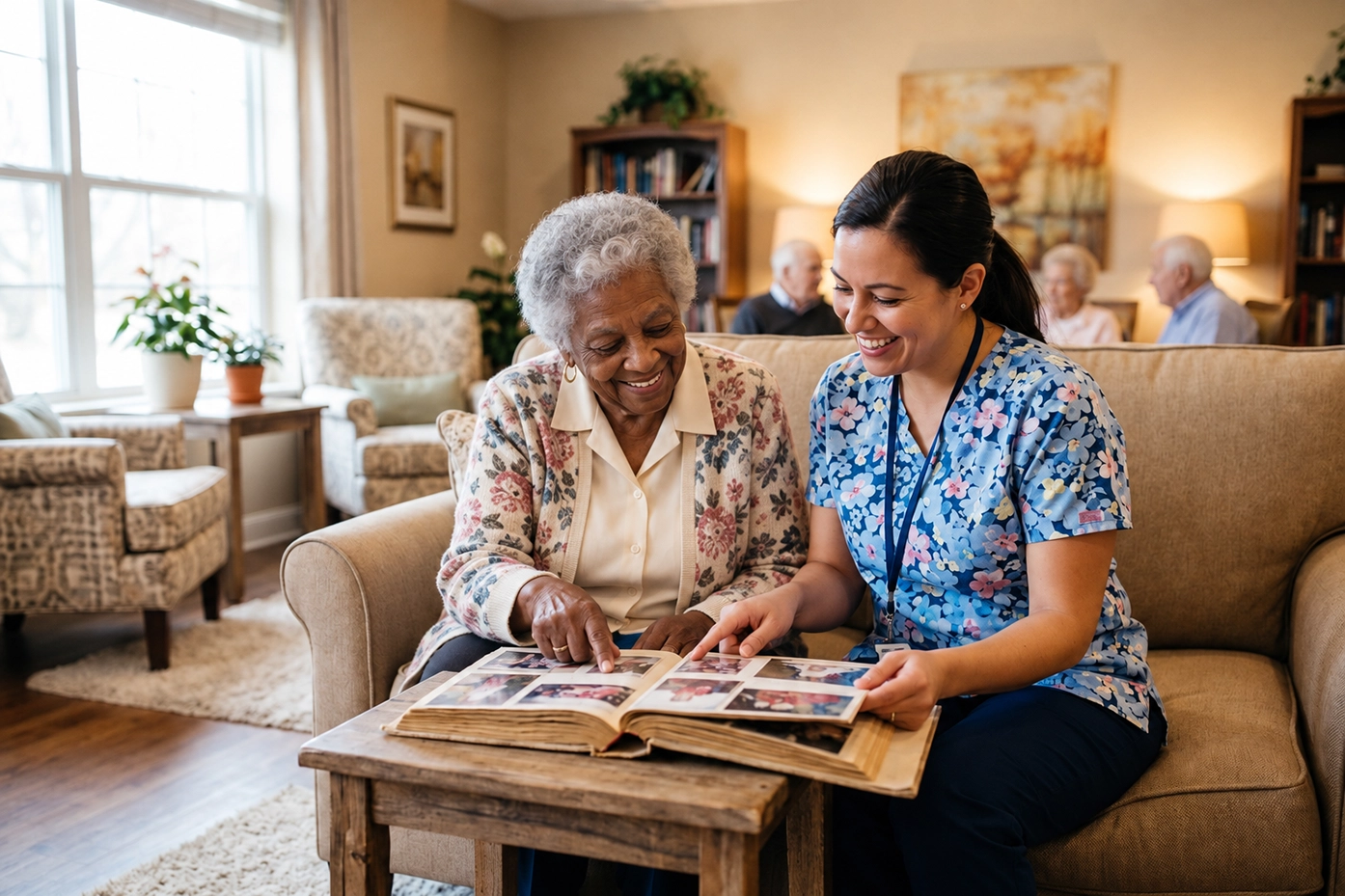
Dementia care in a memory care setting goes beyond supervision. It includes reminiscence therapy, which uses familiar music, photos, or objects to gently engage long-term memory even after short-term memory has faded. It includes art therapy and other specialized activities designed to build on abilities a resident still has, rather than focusing on what’s been lost. Memory care includes activities like music and reminiscence therapy specifically because these approaches are shown to reduce agitation and support a better quality of life, even for dementia patients in more advanced stages. Understanding how your loved one’s dementia typically progresses can also help staff plan activities that meet them where they are.
Staff training matters enormously here. Memory care facilities feature tailored therapeutic activities to stimulate cognition, and the people running those activities are trained to adjust on the fly — scaling an activity up or down depending on how a resident is doing that day. Many of these training curriculums are developed with input from gerontology researchers, including at least one assistant professor at a nursing or public health school who studies memory loss and dementia in older adults.
Inside a Memory Care Community: Daily Life and Cognitive Function
A typical day in memory care follows a rhythm, not a rigid schedule. Mornings often start with a calm routine — breakfast, a familiar song, maybe a walk in a secured courtyard. Structured routines in memory care help reduce confusion and agitation, so staff tend to keep meals, activities, and rest times consistent from day to day. A structured environment is one of the most consistent benefits families report once a loved one settles in.
Residents in memory care benefit from a supportive environment that fosters social connections, even when verbal communication becomes difficult. Group activities are designed to engage residents at whatever cognitive function they currently have, rather than requiring them to keep up with a “normal” pace — things like sorting, folding, music, or simple crafts that offer a sense of purpose and a stronger quality of life day to day. Staff also assist with activities of daily living, from dressing to eating, in a way that preserves as much independence as possible.
Private room and semi private room options are usually both available (many communities also use the term “semi-private”), and most communities let residents personalize their space with familiar photos or furniture, which can genuinely help with orientation and comfort. Specialized activities and cognitive engagement are built into the calendar every day, not offered occasionally as an extra. Most memory care units are designed as a single secured floor or wing, rather than scattered throughout a larger building.
Safety Features That Help Improve Safety for Your Loved One
Safety is really the heart of what makes memory care different from every other senior living option. A secure environment isn’t an afterthought here — memory care environments include secured outdoor areas to prevent wandering, and memory care facilities use alarmed doors to enhance resident safety, both addressing one of the most common and dangerous risks in dementia care: a resident leaving the building unnoticed. Dementia patients can also become distressed in unfamiliar or overstimulating spaces, which is another reason a calm, secure environment matters so much.
Beyond the physical environment, safe environment design also includes things like color-contrasted doorways (which can look like walls to someone with dementia), secured medication storage, and call systems in every private room. This kind of specialized care doesn’t happen by accident. Staff credentials matter here too — ask any community you’re touring about staff training requirements and staffing ratios, since those numbers vary a lot between residential facilities and directly affect how quickly someone notices if your loved one needs help.
The National Council of Certified Dementia Practitioners recommends asking specifically about dementia-specific staff training, not just general caregiving certification, when you’re evaluating a community’s safety practices. Industry data from the National Investment Center for Seniors Housing & Care also shows steady, ongoing demand for memory care nationwide, a reminder that this is a well-established and closely tracked corner of senior housing, not a niche experiment.
What Memory Care Costs
Cost is usually the next big question, and it’s a fair one — memory care is a real financial commitment, and personal care needs typically increase as dementia progresses. Memory care is typically more expensive than assisted living due to increased care needs and security measures, and it often involves higher staff-to-resident ratios compared to other types of senior living, which is part of what drives the cost difference. Costs also vary between stand alone facilities and those attached to a larger senior living campus.
According to AARP, the average monthly cost of memory care was $8,399 in 2023, up from an average of $6,935 a month in 2021 for standalone memory care, according to data cited by Harvard Health. For memory care provided inside a nursing home setting, the average annual cost runs around $116,800. The exact mix of memory care services included in the monthly rate varies by community, so it’s worth asking for an itemized list.
Most families pay for memory care out of pocket, at least initially. Medicare does not cover room and board in memory care facilities, since Medicare generally treats memory care as a housing and personal care service rather than a medical one. That said, there are ways to offset the cost:
- Long-term care insurance — if your loved one purchased a policy years ago, it may cover part or all of memory care, depending on the plan’s terms.
- Veterans benefits — the VA’s Aid and Attendance benefit can help cover the cost of memory care for eligible veterans and surviving spouses.
- Medicare Advantage plans — some Medicare Advantage plans include limited supplemental benefits that can help offset certain care costs, though this varies plan to plan.
- Life insurance living benefits — some policies include living benefits riders that let a policyholder access funds early to help pay for memory care.
Because the rules around coverage and eligibility change and can get complicated, it’s worth talking to an elder law attorney or a benefits counselor before assuming what will or won’t be covered. A short consultation can save your family from a costly surprise later.
Creating a Care Plan for Your Loved One
Once a family decides memory care is the right next step, most communities start with a detailed intake and a personalized care plan. This typically includes input from a trusted doctor, a review of medical history, and a conversation with family members about daily habits, preferences, and what tends to trigger anxiety or agitation for your loved one.
Good care plans aren’t static. They’re revisited regularly and adjusted as a resident’s condition progresses — memory care isn’t a one-size-fits-all service, and a community that treats it that way isn’t doing right by its residents. Good communities also have a system for keeping families informed about changes in mood, health, or behavior, not just at scheduled care conferences. Ask any facility you’re considering how often care plans are reviewed and who’s involved in that process.
How to Choose the Right Memory Care Facility
Touring memory care facilities in person makes a real difference. A few questions worth asking on every visit:
- What’s the staff-to-resident ratio during the day, evening, and overnight?
- What specialized training do staff members complete, and how often is it refreshed?
- How does the facility handle medical emergencies, and how quickly are doctor visits or physical therapists arranged when needed?
- What does a typical day of specialized activities look like?
- Is an unannounced visit allowed after move-in, so you can see the facility on an ordinary day rather than a tour day?
The National Council of Certified Dementia Practitioners and groups like the Alzheimer’s Association both publish detailed checklists worth reviewing before you tour. Many facilities look great on a scheduled visit, so a facility that welcomes a surprise drop-in visit is usually telling you something honest about how it runs day to day.
You may also want to talk with your loved one’s care team, including any physical therapists or specialists already involved, about what the facility should offer given their specific health needs.
Frequently Asked Questions
What’s the Difference Between Memory Care and Assisted Living?
Assisted living facilities are for people who need help with some daily tasks but are otherwise safe and independent. Memory care facilities are for people whose dementia has made independent living unsafe, with added security, structured routines, and staff trained specifically for dementia.
Does Medicare Cover Memory Care?
Medicare does not cover room and board in memory care facilities. It may cover some related medical services, but the housing and personal care costs are typically paid out of families’ own pockets, through long-term care insurance, veterans benefits, or other resources.
When Is It Time to Consider Memory Care for a Parent?
Generally, when memory loss starts to create real safety concerns for your loved one — wandering, leaving the stove on, missed medications, or getting lost in familiar places, and a nursing home level of care isn’t yet needed. Your parent’s physician can help confirm whether memory care or a less intensive option fits their current condition.
What Should I Look for on a Memory Care Tour?
When touring memory care facilities, ask about staff-to-resident ratios, staff credentials and dementia-specific training, how care plans are built and reviewed, safety features like secured outdoor areas and alarmed doors, and whether the community allows visits without advance notice after move-in.
Taking the Next Step
Deciding on memory care for a parent is rarely easy, and there’s no version of this decision that doesn’t come with some worry. But getting clear on what memory care facilities actually offer — the safety, the structure, the specialized support — can make the decision feel less overwhelming and more like what it really is: a way to keep your loved one safe while preserving as much quality of life as possible.
If you’d like to talk through your family’s situation or see what daily life looks like in person, we’d be glad to help. You can schedule a visit to see our household-model approach to care firsthand, or explore our full range of senior care services to find the right fit for your family.