
Visiting someone with dementia can feel different from any other visiting you’ve done before. Maybe the last time you saw your parent, they didn’t recognize you right away. Maybe the conversation went in circles, or they seemed upset for reasons you couldn’t quite follow. It’s okay if visiting someone with dementia feels a little intimidating right now — most families feel that way at first, especially a friend or family member who hasn’t done much visiting since the diagnosis, since family and friends often aren’t sure what to expect the first time.
This guide walks through what actually helps when you’re visiting: how to plan a visit, what to talk about, what to bring, how to handle hard moments if they come up, and how to take care of yourself once you’re done visiting for the day. Every tip here comes with the reason behind it, so you’re not just following a checklist — you’ll understand why it works. Visiting loved ones with dementia gets easier with practice, even when the first few times feel awkward. If you’re also trying to understand memory loss itself, our guide on what memory care is is a good companion read.
Why Visiting Still Matters
It’s easy to wonder whether visiting even registers, especially once memory loss is advanced, often as a result of Alzheimer’s disease or another type of dementia. It does. Regular visits improve emotional well-being for dementia patients, even when the person can’t recall the visit afterward — because people living with dementia often remember how visiting made them feel, long after the specific details have faded. That’s really the point of visiting: it isn’t about being remembered later. It’s about the connection in the moment. Many seniors in memory care look forward to a visit all week, even if they can’t always say so.
Visiting also helps reduce feelings of loneliness and depression in dementia patients, and frequent visits can enhance recognition and emotional connection over time. Many families notice a loved one seems calmer, or more like themselves, for a while after someone familiar has been visiting, even if they couldn’t have told you who visited an hour later. Regular visiting is one of the most meaningful ways to stay connected and offer real support during this stage of life, whether it comes from a family member or a close friend. Choosing to spend time together regularly, even in small doses, is what matters most.
Planning the Visit: Timing That Actually Helps
When you’re visiting matters almost as much as how you’re visiting. Plan visits during times when the person is most alert and calm — for a lot of people living with dementia, that’s the middle of the day, before fatigue and “sundowning” (a common late-afternoon increase in confusion or agitation) sets in. Visiting during the middle of the day tends to support better engagement and a more successful visit overall.
One to three visits per week is often ideal for dementia patients, though that’s a general guideline for how often to spend time visiting, not a rule — some families do short visits daily, others coordinate visits among several family members so their loved one has regular company from friends and family without any one person feeling stretched thin. Establishing a loose visiting routine, even something as simple as “Sundays after lunch,” provides a sense of structure that can be genuinely calming. If your family is still early in this adjustment period, it’s fine to start with shorter, less frequent visits and build from there as everyone gets more comfortable visiting and adjusts to this new environment together.
It’s also worth checking with staff before your next visit. Many senior living communities and memory care settings plan visits around special events on the calendar — a music program, a holiday gathering — and timing your visiting around one of those can give you something easy to enjoy together. Other visitors, including staff who know your loved one well, can often tell you which time of day tends to go best.
Before You Walk In: Preparing Yourself
A little mental preparation goes a long way before visiting. Remind yourself that the person you’re visiting may not be exactly who you remember from a year or two ago, and that’s not a reflection of how much they care about you — it’s the disease. Walking in with that expectation already in mind makes it much easier to stay calm if visiting doesn’t go the way you pictured it.
It also helps to have a loose plan for what you’ll do together while visiting, rather than showing up with nothing but conversation to lean on. A specific plan — a photo album, a favorite song, a simple task like folding towels together — gives your visiting somewhere to go if conversation stalls, and it can make even a short visit feel like quality time together rather than an obligation. Sometimes the best visit is simply sitting together, enjoying each other’s company without needing to fill every silence.
What to Talk About While Visiting
Conversation with someone with dementia works best when it’s simple, present-focused, and doesn’t rely on short-term memory. Ask simple closed questions instead of open-ended ones — “Did you enjoy your lunch?” tends to land better than “What did you have for lunch?” because it doesn’t put the person on the spot to recall a fact they may not have retained.
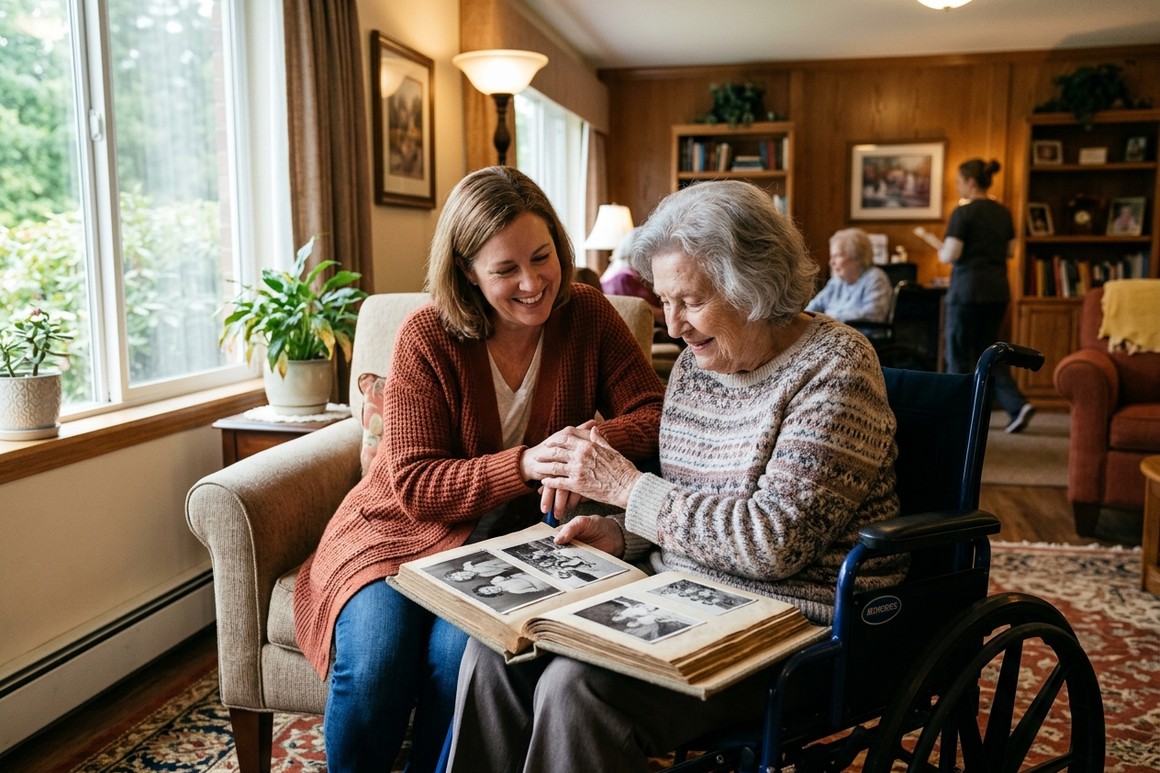
A photo album is a great conversation starter for visiting, especially older photos tied to long-term memory, which tends to stay more intact than recent memory. Photo albums can stimulate conversation and reminiscing in a low-pressure way — there’s no wrong answer to “tell me about this one.” Familiar stories, favorite music, or a memory box of meaningful small objects can work the same way while visiting: they give the person you’re visiting something concrete to respond to, rather than an abstract question to answer from scratch. If you’re not sure what to bring along, even one simple story you both remember can carry a whole conversation — a funny old story often does more for a visit than any deep conversation could.
One of the most important things to avoid while visiting: never argue or correct misremembered facts; instead, validate feelings. If your loved one insists it’s 1985, or asks about a parent who’s passed away, correcting them rarely helps and often causes real distress. Validating feelings rather than correcting a person’s misremembering keeps visiting calm and lets the person you’re visiting feel heard instead of wrong. If they’re missing someone, you can gently acknowledge the feeling (“You miss her, don’t you?”) without necessarily correcting the timeline. Avoiding arguing about facts, and simply listening to the feeling underneath, tends to make for a much better visit for everyone.
What to Bring for a Visit
A few simple things can make visiting go more smoothly:
- A photo album — old photos are a reliable way to spark conversation and reminiscing while visiting, since long-term memory tends to hold up better than recent memory.
- Music from their younger years — listening to music can be a meaningful activity during visits, and familiar songs often reach people even in later stages of dementia.
- A small, calming task — folding laundry, sorting buttons, or light gardening can provide calming engagement without requiring conversation to carry the whole visit.
- A favorite snack or simple meal — sharing a meal together is a familiar, comforting ritual that doesn’t depend on memory at all, and it can turn a quiet visit into fun without much effort.
Engaging in sensory activities can enhance connection while visiting generally — touch, familiar scents, and music tend to reach people even when words are harder to come by. Something as small as holding hands or making gentle eye contact can carry a conversation that words can’t.
Communication Tips for Visiting
How you speak matters as much as what you say while visiting. A few habits make a real difference:
- Introduce yourself each time you visit to aid recognition, even if you’re sure they’ll know you — a simple “Hi Mom, it’s me” removes any pressure on them to place you.
- Speak slowly and clearly using short, simple sentences, and limit choices to enhance decision-making (“Would you like tea or water?” rather than a long list of options).
- Approach from the front door or entryway to avoid startling a person with dementia, and get down to eye level to project a relaxed presence rather than looming over them.
- Maintain a calm environment by reducing background noise while visiting — a quiet activity in a quiet space helps reduce confusion, since a loud TV or crowded common room can make it much harder to follow what’s being said.
- Use familiar items to stimulate conversation and connection, and give plenty of time to process and respond — people with dementia often need a few extra seconds to answer, and jumping in too quickly can be more disorienting than helpful.
- Pay attention to body language, too — tone, posture, and facial expression often say more than words during a visit.
- Listen more than you speak. Sometimes the most helpful thing you can do is listen, even when the words don’t fully make sense.
Communicating clearly and respectfully while visiting isn’t just good manners — it directly affects how safe and understood the person feels in that moment, and it shows real respect for who they still are. These tips apply whether you’re visiting daily or just once a month.
Handling Hard Moments While Visiting
Even a well-planned visit can hit a rough patch, and that’s normal. If your loved one gets upset or wants to go home, avoid arguing about it. Trying to reason someone out of a strong feeling rarely works with dementia, and it can make the moment worse. Instead, acknowledge what they’re feeling, gently redirect to something calming — a familiar song, a short walk, a favorite snack — and give it a few minutes.
If the person doesn’t seem to recognize you at all while visiting, try not to take it personally in the moment, even though it understandably hurts. Reintroduce yourself warmly rather than asking “Don’t you know who I am?” — a question like that puts the person on the spot and rarely improves things. As the Alzheimer’s Association notes, focusing on the emotional tone of an interaction, rather than whether specific facts land, tends to lead to calmer visiting for everyone involved. This is also where patience matters most — not every hard moment needs an explanation, just comfort. Visiting someone in the later stages of dementia often looks different from visiting someone in the early stages, and that’s expected; as dementia progresses, visits may need to get shorter and simpler, and that’s a normal adjustment, not a failure.
Bringing Children Along When Visiting
Bringing children can help maintain important relationships between generations, and most kids handle visiting better than parents expect — especially with a little preparation. Discuss dementia with children before their visit, in simple, honest language suited to their age, so they know what to expect and aren’t caught off guard by unfamiliar behavior. Being able to explain, in a sentence or two, why grandma might seem confused goes a long way toward a comfortable visit.
Children can engage in activities like coloring or crafts during visits, which gives them something to do and often draws a grandparent into the moment too. It helps to coach children beforehand that they should speak clearly and avoid arguments during visits, the same as adults — correcting a grandparent’s confusion isn’t a child’s job to sort out, and it’s kinder to redirect than to argue. Most children turn out to be more naturally interested and at ease with a grandparent’s dementia than the adults around them expect.
Ending the Visit Well
How a visit ends matters. Avoid long goodbyes to reduce distress — a drawn-out farewell can unsettle a person with dementia and undo some of the calm you built while visiting. A brief, warm goodbye, sometimes without announcing it as a “goodbye” at all (“I’ll see you soon”), tends to land more gently than a long, emotional send-off.
If your facility keeps a guest book, it’s worth using. A visitor guest book helps track visits and activities, and can serve as a conversation starter for future visitors and staff alike — a quick note about what worked well today (“loved the music, seemed upset by the news on TV”) can help the next visitor, whether that’s you at your next visit or another family member. Most memory care communities welcome visitors any time of day, though checking with staff first about visitors is still a good idea, since it’s really an extension of good dementia care to keep everyone on the same page.
Taking Care of Yourself After Visiting
Visiting a loved one with dementia can bring up a lot of feelings — grief, guilt, tenderness, exhaustion, sometimes all at once. That’s a normal response to watching someone you love change, not a sign you’re handling visiting wrong. Naming those feelings out loud, even just to yourself, can make a visit feel more honest. Give yourself permission to feel whatever comes up after visiting, and talk to someone — a friend, a family member, a support group — if it’s weighing on you. Protecting your own self-esteem through this process matters too; feeling unsure during a visit doesn’t mean you’re doing it badly.
Staying connected doesn’t mean every visit has to be perfect. Some visiting will go smoothly; other visits won’t, and that’s part of this. What matters more than any single visit is staying involved over time, in whatever way is sustainable for your family, your friends, and your own well-being. A support group for families of people living with dementia can also offer practical advice and provide comfort on the days visiting feels especially hard, and it’s often easier to keep visiting your loved one when you don’t feel like you’re doing it alone. Even bringing a friend along on a visit sometimes can help both of you.
Frequently Asked Questions
How Often Should I Visit Someone With Dementia?
One to three visits per week is often a good target once your family has settled into a rhythm of visiting, though there’s no single right answer. Short, regular visits tend to help a person with dementia feel safe and secure more than occasional long ones.
What Should I Talk About With Someone Who Has Dementia?
Keep it simple and present-focused while visiting. Ask closed questions, bring up long-term memories with the help of an old photo or a familiar song, and follow their emotional lead rather than steering the conversation toward facts they may not recall.
What Should I Do If They Don’t Recognize Me?
Reintroduce yourself warmly and without pressure. It’s painful, but it isn’t a reflection of your relationship — it’s the disease. Focus on making the moment feel safe and pleasant rather than on being recognized, and keep visiting on a regular schedule anyway, since familiarity builds over time even without direct recognition.
Should I Bring Children to Visit?
In most cases, yes, with a little preparation. Explain dementia to them in simple terms beforehand, bring along a small activity like coloring, and let them see that it’s okay to have a warm visit even if their grandparent seems different than they remember.
Related Reading
If you’re still working out whether your loved one’s memory changes point to normal aging or something more, our guide to what memory care is covers how it differs from assisted living and a nursing home, along with early signs families notice before they start visiting a memory care community for the first time. And if you’d like to see a memory care community in person, we’d be glad to have you schedule a visit.