Nobody hands you a guide to stroke rehab for seniors before the phone rings. One minute life is normal; the next, your mom or dad is in the hospital, the doctors are using words like “ischemic” and “deficits,” and someone on the care team is asking where your parent will go next. You haven’t even caught your breath, and you’re already expected to make decisions you’ve never had to think about before.
Most families in this spot feel the same mix of relief and dread. Relief that their loved one survived. Dread about what comes next, how much help they’ll need, and whether they’ll ever get back to the life they had. The good news is that the path forward is better mapped than it feels right now. Stroke rehabilitation has decades of research behind it, and families who understand how it works tend to make calmer, better decisions. This guide walks you through what to expect, where rehab happens, how long it takes, and how you can help.
What Is Stroke Rehabilitation, and Why Does It Matter for Older Adults?
Stroke rehabilitation is a set of therapies that help a person relearn the skills a stroke took away. Mayo Clinic describes it as a program built around the parts of the brain the stroke affected, with the goal of improving movement, speech, strength, and daily living skills.
Here’s why that matters. A stroke happens when blood flow to part of the brain is cut off, and the brain cells in that area are damaged. When a stroke damages one region, the abilities that region controlled are the ones that suffer. The effects of stroke depend entirely on which area was hit. One person loses strength on one side of the body. Another struggles to find words. A third can’t swallow safely. Rehab is how the brain gets a second chance, because it can form new connections around the damaged area with enough practice. The goal is to help stroke patients regain as much independence as possible, whether that means walking unassisted again or simply handling daily tasks without help.
For an elderly patient, rehab is also what stands between a hospital bed and getting home. Mayo Clinic notes that people who take part in a focused stroke rehabilitation program do better than people who don’t, and it’s recommended for everyone who has had a stroke. Age alone isn’t a reason to skip it. The MSD Manual puts it plainly: treatment decisions for older adults should be based on the person’s overall health, not their age.
What Kinds of Problems Can Seniors Have After a Stroke?
Every stroke is different, but a few problems come up again and again. Knowing what they are helps you spot them early and ask the right questions.
Movement and balance. Weakness or paralysis on one side of the body is the most common effect. Many stroke survivors also deal with dizziness or poor balance, which raises the risk of a fall. If your loved one feels dizzy after a stroke, tell the rehab team right away. Physical therapists have specific exercises for balance and dizziness, and the problem is often treatable.
Speech, language, and swallowing. Some people can’t find words. Others understand everything but can’t get the words out. Trouble swallowing is especially important to catch, because it can lead to choking or pneumonia. Speech therapists handle all three.
Thinking and memory. Attention, problem-solving, and memory can all take a hit. This can look like confusion or forgetfulness, and it’s frightening for families who worry it’s permanent. Often it improves with therapy.
Mood. This one gets overlooked. The American Heart Association reports that depression and anxiety are common after a stroke and can make a survivor less willing to take part in rehab. If your parent seems withdrawn or hopeless, say something. Treating mood problems is part of stroke care, not a side issue.
When Does Stroke Rehab Begin?
Sooner than most families expect. Rehab usually begins in the hospital, often within 24 to 48 hours of the stroke, as long as the patient is medically stable. The American Heart Association’s updated adult stroke rehabilitation guideline says that in the best case, patients can start rehab the day after their stroke. Those first days might involve nothing more than sitting up in bed, stretching, or practicing simple self-care tasks. But they count.
There’s a reason doctors push to start early. In the weeks after a stroke, the brain is unusually ready to rewire itself. Therapy during that window gets more out of every session than therapy started months later.
Where Can Seniors Get Rehabilitation After a Stroke?
Before your loved one leaves the hospital, the care team will talk with you about the next setting. This is one of the biggest decisions you’ll make, and it helps to know the options going in. The American Stroke Association lists four main settings.
| Setting | Who it fits | What to expect |
|---|---|---|
| Inpatient rehabilitation facilities (IRFs), sometimes called a rehabilitation hospital | Patients who can handle an intensive inpatient stroke program, usually about three hours a day, five days a week | Hospital-level care with a full rehab team on site; stays are often two to three weeks |
| Skilled nursing facilities (SNFs) | Seniors who need daily therapy plus nursing care but can’t manage three hours a day yet | Physical, occupational, and speech therapy at a gentler pace, with around-the-clock nursing |
| Outpatient rehabilitation | Patients who are safe at home and can travel to appointments | A few hours of therapy, a couple of days a week |
| Home-based rehab | Patients who need lighter support or can’t travel | Therapists visit the home; flexible, but usually without specialized equipment |
For many older adults, especially those who were already a little frail before the stroke, a skilled nursing facility is the realistic middle ground. They need more care than home can provide, but three hours of intense therapy a day would wear them out. A good short-term care setting gives them a rehab team, nursing support, and time to rebuild strength safely before the transition back home. Many patients move through more than one of these settings, starting in an inpatient stroke unit and stepping down to a skilled nursing or outpatient program as they improve. Whichever setting you choose, ask whether it runs a dedicated stroke program rather than general rehabilitation programs only.
If you’re weighing this choice in New Orleans, our short-term care program at St. Margaret’s at Mercy and St. Jude’s offers on-site physical, occupational, and speech therapy for people recovering after a hospital stay, along with 24-hour skilled nursing. We also wrote a separate guide on rehab vs. long-term care if you’re not sure which one your parent needs.
What Does Stroke Rehab for Seniors Actually Involve?
The word “rehab” covers a lot of ground. In practice, it’s a handful of therapies working together, each aimed at a different part of recovery. Here’s what each one does and why it matters.
Physical Therapy
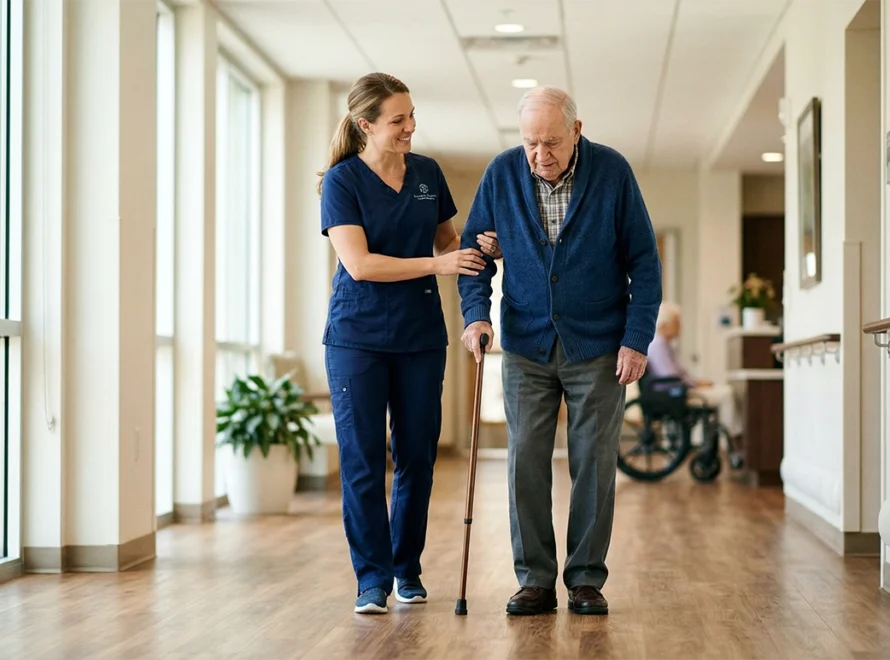
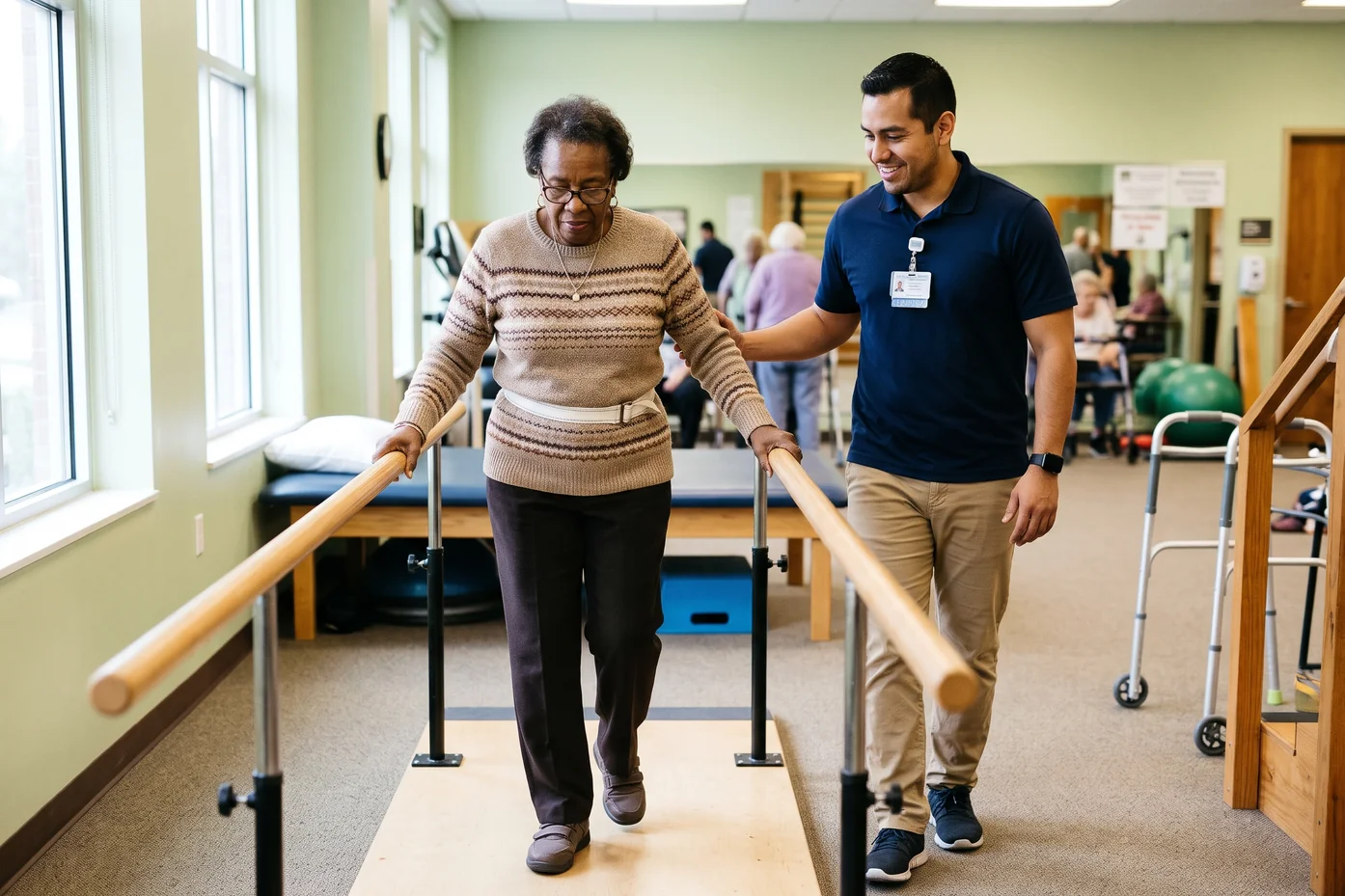
Physical therapy focuses on getting the body moving again. That means strength, coordination, balance, and walking. A physical therapist might start with helping your parent sit up and stand, then move on to walking with a walker or cane, then climbing stairs. It’s hands-on training to help the body regain function, and it’s the part of physical rehabilitation most families picture when they hear the word “rehab.” The benefit is simple: the more you improve physical strength and mobility, the more independence your loved one gets back, and the lower their fall risk.
Occupational Therapy
Occupational therapists help patients relearn everyday activities: dressing, bathing, cooking, using the bathroom, and getting in and out of a chair. They also teach workarounds, like one-handed techniques or assistive tools such as a reacher or a one-handed cutting board, for daily activities that don’t fully come back. If the goal is getting home, this is the therapy that makes home workable.
Speech Therapy
Occupational and speech therapists often work side by side, but speech therapists do more than help with talking. They work on understanding language, reading, writing, and memory, and they’re the ones who evaluate whether it’s safe to swallow food and liquids. Swallowing problems are common after a stroke and dangerous when missed, so this therapy helps protect your parent’s health as much as their voice.
Cognitive and Emotional Support
Rehab also covers the cognitive and emotional side of recovery. Psychologists and counselors help with mood, and support groups connect survivors and families with others going through the same thing. Mayo Clinic lists all of this, along with medication for depression when needed, as a normal part of stroke rehabilitation.
Who Is on the Rehab Team?
Stroke rehabilitation works best as a team approach, and the team is bigger than most families expect. According to Mayo Clinic, the team includes a physician who oversees the plan (often a physiatrist, a doctor who specializes in physical medicine and rehabilitation), rehabilitation nurses who help patients practice skills between sessions, physical and occupational therapists, speech therapists, a social worker who helps with resources and living arrangements, and a psychologist. Some rehab programs add a dietitian, since stroke survivors are at risk of poor nutrition early on, especially when swallowing is affected.
The important thing for families is that these people talk to each other. An experienced team will also tell you what stage of recovery your parent is in and what the next milestone looks like. Ask how the team coordinates. A good program meets regularly to update the treatment plan as your loved one improves.
How Long Does Stroke Recovery Take for Older Adults?
Most motor gains happen in the first three months, but recovery can continue for a year or more, and sometimes much longer. That’s the honest answer, and it comes from the American Heart Association, which notes that language and thinking skills can keep improving well past the three-month mark. Mayo Clinic adds that improvement can continue 12 to 18 months out, and that most people need some form of long-term rehab lasting months or years.
So how long will rehab be needed? Stroke recovery in older adults depends on the severity of the stroke, your parent’s overall health, how early therapy started, and how much they practice outside of sessions. The first few weeks or months are the most intense. After that, therapy usually tapers to outpatient visits or a home exercise program.
One thing worth saying out loud: the goal of rehab isn’t always to get back to exactly how things were. For many seniors, the goal is to recover as much function as possible and build workarounds for the rest. That’s still a win, and it’s what life after stroke looks like for many people. An 85-year-old who can walk to the dining room, feed herself, and hold a conversation with her grandkids has gotten her life back, even if she needs a cane now.
Can a Senior Fully Recover From a Stroke?
Some do, and many patients get better after a stroke to a degree their families never expected. But nobody can promise a full recovery, and you should be wary of anyone who does. Recovery depends on physical factors (how severe the damage was), emotional factors (motivation and mood), social factors (support from family and friends), and the quality and timing of therapy. The one you have the most control over is social support, and it matters more than people realize.
What families often ask next is whether a mild stroke still needs rehab. Yes. Even after a mild stroke, a rehab evaluation is worth doing, because small problems with balance, attention, or speech are easy to miss and easy to treat early. A mild stroke is also a warning. Follow-up with the doctor, managing blood pressure and other risk factors, and staying active are all part of preventing another stroke.
How Can Families Help a Senior Through Stroke Rehab?
You’re part of the rehab team whether anyone tells you so or not. The American Heart Association describes rehab as a time for patients and caregivers to learn together, and notes that a stroke affects the whole family, not just the survivor. Your support and encouragement are part of the therapy, and the education and support you get from the team are part of yours. Here’s how to help your loved one without burning yourself out.
Show up for therapy sessions when you can. You’ll learn the exercises, see what your parent can and can’t do safely, and hear the therapists’ advice firsthand. That makes it much easier to support and encourage practice between sessions.
Encourage practice, but don’t take over. The temptation is to do things for your parent because it’s faster. Resist it. Every time they button their own shirt or walk to the window, that’s rehab. Think of it as therapy to help them relearn skills, one small task at a time. Patience here pays off in independence later.
Watch for mood changes. You know your parent better than the staff does. If they seem down, withdrawn, or unusually irritable, tell the team. Depression after a stroke is treatable, and treating it helps everything else go better.
Take care of yourself. Caregiver burnout is real, and it sneaks up on people. Use the social worker. Ask about support groups. Accept help from siblings and friends. If you need a break down the road, respite care exists for exactly this reason.
Does Medicare Cover Stroke Rehab for Seniors?
Often, yes, though the rules have a few catches. Medicare Part A covers care in a skilled nursing facility only after a qualifying inpatient hospital stay of at least three days in a row, and it covers up to 100 days of SNF care per benefit period, according to Medicare.gov. The first 20 days are fully covered; days 21 through 100 carry a daily coinsurance. Covered rehabilitation services help pay for the therapy itself, the room, meals, and nursing care during that stay.
The catch that trips up families: time spent in the hospital under “observation” doesn’t count toward the three-day requirement, even if your parent was there for three days. Ask the hospital directly whether your loved one was formally admitted as an inpatient. Medicare Advantage plans have their own rules and may waive the three-day stay, so check with the plan. For a fuller picture, see our guide to what Medicare covers in a nursing home and our overview of paying for senior care.
How Do You Know If a Rehab Facility Is Any Good?
Look for accreditation first. The Joint Commission and the Commission on Accreditation of Rehabilitation Facilities (CARF) both review rehabilitation facilities against national standards, and either one is a sign the program takes quality seriously. Then ask practical questions: Is there a dedicated stroke recovery program, or is stroke rehab folded into general therapy? How much therapy will my parent get each day? Who’s on the rehab team, and how often do they meet? What’s the nurse-to-resident ratio at night? How do you handle swallowing problems? What happens if my parent isn’t progressing?
Then go see it. A tour tells you things a brochure can’t. Watch how staff talk to residents. Look at the therapy gym. Notice whether people seem engaged or parked in front of a TV. A strong stroke rehab program will be able to tell you how it helps residents achieve the best recovery they can. If you’re comparing options in the New Orleans area, our article on questions to ask during a nursing home tour gives you a full checklist.
Frequently Asked Questions About Stroke Rehab for Seniors
What Should You Do Right After a Mild Stroke?
Follow up with the doctor, get a rehab evaluation even if the symptoms seem minor, and take the stroke seriously as a warning sign. Managing blood pressure, cholesterol, and blood sugar, staying physically active, and taking the types of medicines your doctor prescribes all lower the risk of a second stroke. The American Heart Association notes that physical activity also supports thinking and memory during recovery.
How Is Dizziness After a Stroke Treated?
Tell the care team first, because dizziness can have several causes, including medication side effects and problems with the balance system. Physical therapists use targeted balance and vestibular exercises, and the doctor may adjust medicines. It’s one of the more treatable post-stroke problems, so don’t let your parent just live with it.
Is Stroke Rehabilitation for Elderly Patients Different From Rehab for Younger People?
The therapies are the same, but the pace and the goals often differ. Older adults are more likely to have other health conditions that affect how hard they can push, and they’re at higher risk for complications like pressure sores and pneumonia during recovery. A good program accounts for that, adjusting intensity so your parent makes steady gains without setbacks. The MSD Manual notes that rehab for older adults should be individually designed for exactly this reason.
What Does the Rehab Team Do if My Parent Isn’t Improving?
They should tell you, explain why, and adjust the plan. Plateaus happen, and they don’t always mean recovery is over. Sometimes the fix is a different therapy approach. Sometimes it’s treating an underlying problem like depression or poor sleep. Ask the team directly what they’re seeing and what the next step is.
Taking the Next Step After a Stroke
Stroke rehab for seniors is a marathon, not a sprint, and the first stretch is the hardest. But families who understand the process, ask good questions, and stay involved give their loved one the best chance at a strong recovery. The brain is more adaptable than most people think, and older adults can and do make real gains with the right support.
If your parent is in the hospital right now and you need a short-term rehab option in New Orleans, we’d be glad to talk with you. Schedule a visit to St. Margaret’s at Mercy or St. Jude’s, or learn more about our on-site therapy services. We’ll help you figure out what your loved one needs and what comes next.